Toast auto-sync
If your POS is Toast, you don't have to export anything. Connect your Toast account once and Rinvy signs in each morning, pulls the Item Details sales report, and files the results exactly where a CSV upload would land — matched to your menu items and ready for food cost, variance, and ordering.
Every other POS still works the same way it always has: export a report and upload the CSV.
Before you start
The recommended setup is a dedicated Toast user created just for Rinvy:
- Give it reporting access and nothing else.
- Don't enable 2FA on it.
- Use an address you control, like
reporting@yourrestaurant.com.
That keeps your personal Toast login (and its 2FA) untouched, and makes it obvious in Toast's audit log which sign-ins are Rinvy's. Your password is encrypted before it's stored and is never displayed again after you save it.
Connecting
Go to Kitchen Settings and open the Integrations section.
- Under Toast auto-sync, enter the Toast email and password.
Press Connect to Toast. Rinvy saves the credentials, signs in, and discovers every location on the account. This takes a minute — the button shows "Connecting…" while it runs.
Under Locations to sync, tick the locations that feed this restaurant. Most kitchens pick one; a Toast account covering several storefronts will list them all.
Pick a Daily sync time. It runs once a day at that hour, in your restaurant's timezone.
Turn on Automatic daily sync and press Save settings. The toggle stays locked until at least one location is selected.
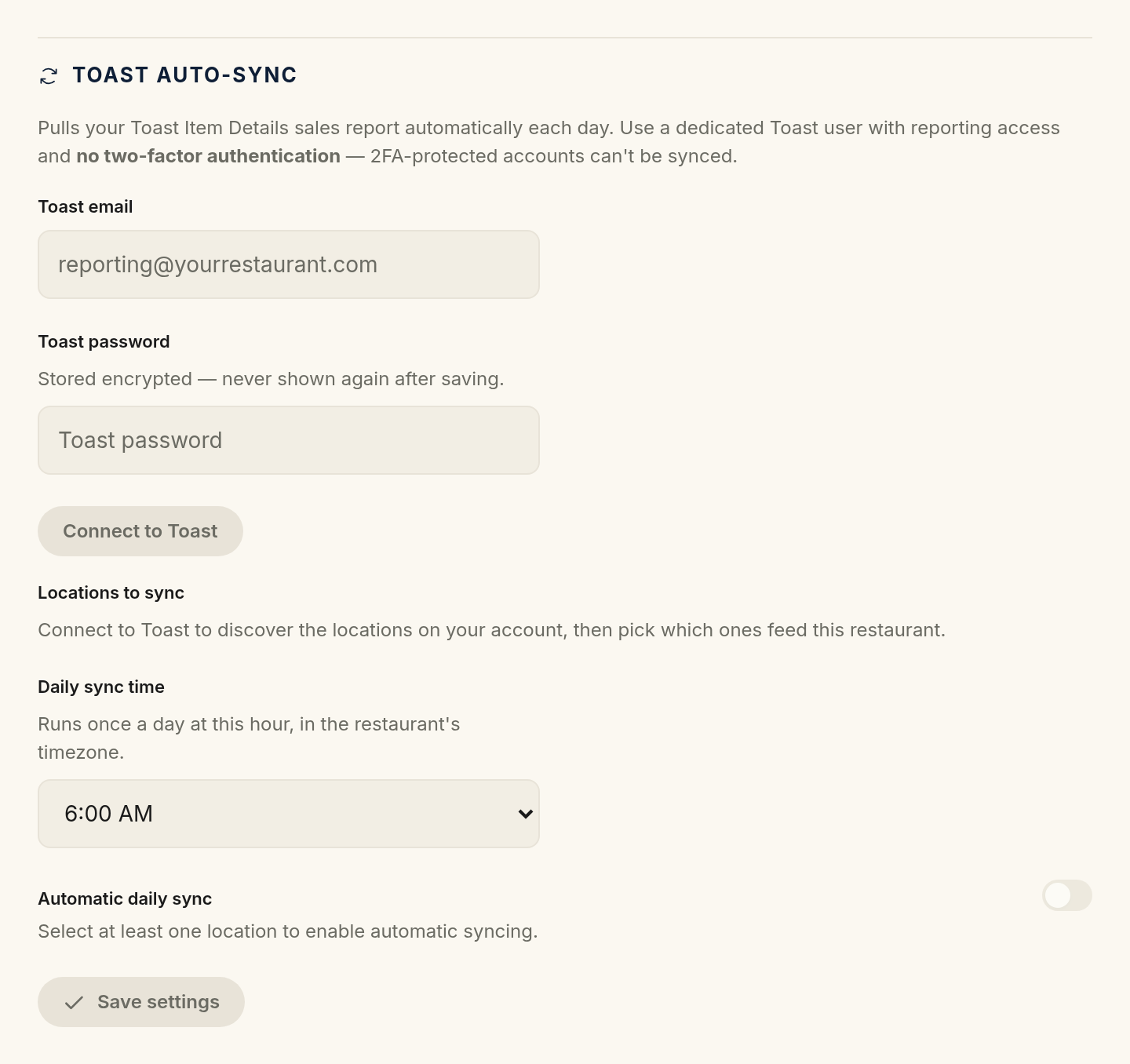
Pick a sync hour comfortably after your business day closes. Rinvy syncs through yesterday, so an early-morning slot (5–7 AM) gets you a complete previous day before anyone opens the app.
What a sync pulls
Each run asks Toast for every day from the last successful sync through yesterday, so a missed day catches up on its own the next morning. Two limits are worth knowing:
- A single run covers at most 30 days. A connection that's been broken longer than that resumes 30 days back, not from where it stopped — older days need a manual range.
- If the last sync already reached yesterday, the run does nothing rather than re-importing the same day.
Sales arrive by business date, which respects the business-day cutoff set in Kitchen Settings — a 2 AM sale with a 4 AM cutoff counts toward the previous day, exactly as it does in Toast.
Matching still applies
A synced day goes through the same matching step as an uploaded CSV:
- Every line matched — the sync completes on its own and the sales are live. Nothing for you to do.
- Any line unmatched — the import parks on Sales data as pending review, exactly like an ambiguous upload. Open it, point each unmatched POS item at the right menu item, and confirm.
So auto-sync removes the export-and-upload chore, not the need to keep your menu items in sync with the POS. A brand-new Toast item will hold up its day's import until someone maps it once — after which Rinvy remembers the mapping and later syncs match it automatically.
Sync status
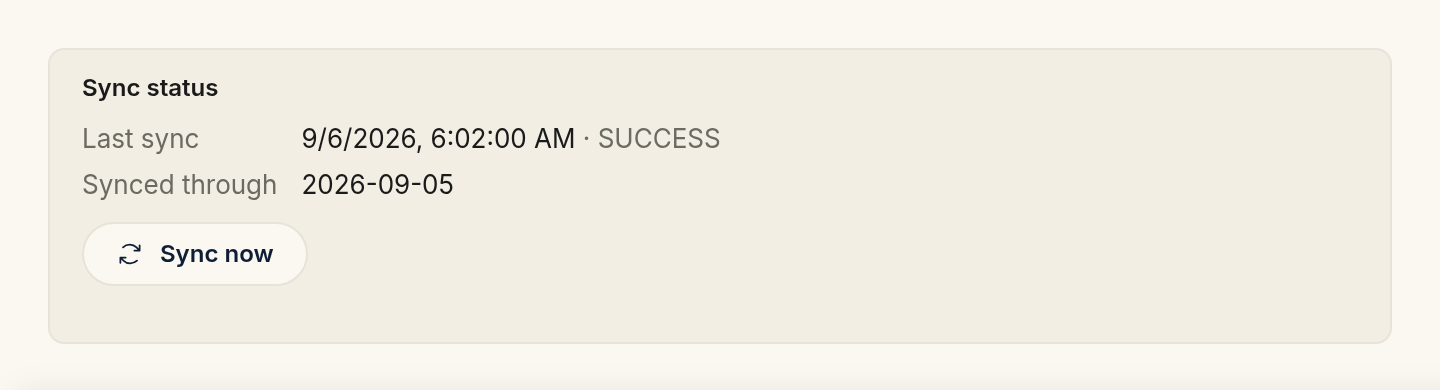
Once configured, a Sync status block shows:
- Last sync — when it last ran, and whether it succeeded or failed.
- Synced through — the most recent business date successfully imported. This is the real progress marker; check it first when a number looks stale.
- Consecutive failures — a running count, shown only when it's above zero.
Sync now fires a one-off run immediately, outside the schedule. Use it after fixing credentials, or when you want today's numbers before tomorrow's scheduled run.
When syncing breaks
After three consecutive failures, Rinvy turns automatic syncing off and records the reason next to the failure count. This is deliberate — a login that's been rotated or locked shouldn't keep hammering Toast every morning.
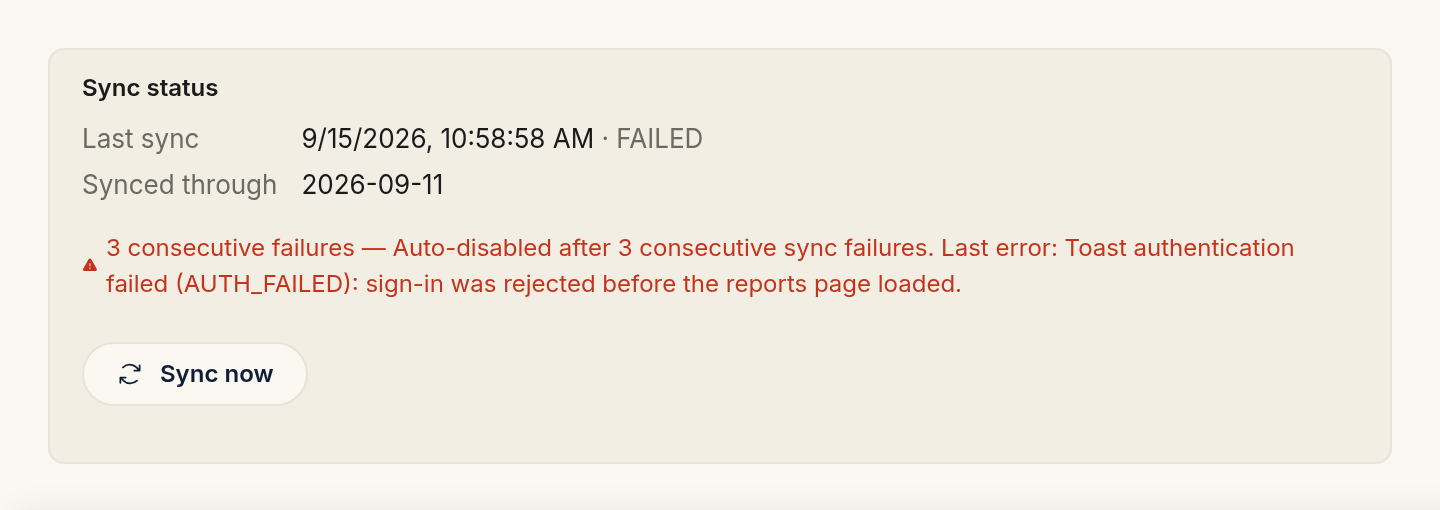
To recover: fix the underlying cause, press Reconnect to Toast to re-authenticate, then turn Automatic daily sync back on and save. The failure count resets on the first success, and the catch-up window pulls back the days you missed (up to 30).
Common mistakes
Enabling 2FA on the synced Toast account later
A sync that has been working for months stops the day someone turns on two-factor auth for that Toast user. The failure count climbs and auto-sync disables itself after three days. Use a dedicated reporting user so a security change to a personal login doesn't take sales data with it.
Changing the Toast password without updating Rinvy
Rinvy stores the password you gave it. A Toast-side password rotation breaks the next sync — re-enter the new password and press Reconnect to Toast.
Assuming a green sync means the sales are live
A sync that finds unmatched items completes as pending review, not as finished data. If variance or food cost looks like it's missing a day, check Sales data for an upload waiting on you.
Uploading a CSV for a range auto-sync already covers
Rinvy doesn't dedupe overlapping ranges. Uploading last week's CSV on top of a week auto-sync already imported double-counts those days. Once auto-sync is on, let it own the ongoing feed and only upload CSVs for history from before you connected.
Picking every location on a multi-site Toast account
Locations you tick all feed this Rinvy restaurant, summed together. If you run two storefronts as two Rinvy kitchens, connect each one to its own location — otherwise both sets of sales deplete one kitchen's stock.